

I still remember the first piece of tramp art I ever held. It was a small, intricately layered picture frame at a dusty flea market in Pennsylvania. The dealer, a grizzled old picker with hands like tanned leather, called it “hobo art” and shrugged. “Some wandering soul made it during hard times out of old cigar boxes,” he said. I turned it over, feeling the hundreds of tiny notched triangles under my thumb. The frame practically hummed with patience. That day, I bought it for $18, and I’ve been hooked ever since.
If you’ve spotted similar chip-carved wooden wonders at antique shops, estate sales, or online auctions and wondered what is tramp art exactly, you’re not alone. This oddly named folk art form has surged in collector interest, but its story remains stubbornly grounded in the makeshift, resourceful, and often anonymous hands that built it. In this guide, we’ll walk through everything you need to know — from spotting an authentic tramp art frame to judging the patina on a rare tramp art box, and understanding why the term hobo art still stirs debate among scholars. Let’s dig into the wood chips.
What Is Tramp Art? A Definition Wrapped in Wood Chips
Let’s start right at the core: what is tramp art? At its simplest, tramp art is a form of folk art made primarily between the 1870s and the 1940s, characterized by chip-carved, layered wood pieces — often assembled from discarded cigar boxes, shipping crates, and scrap lumber. Makers would whittle notches, geometric patterns, and intricate layered tiers, stacking layer upon layer of thin wood to create everything from small keepsake boxes to full-sized furniture. The wood wasn’t painted; it was left natural or given a dark varnish, and the overall effect is unmistakably handcrafted, even “crusty” in the best possible way.
But what is tramp art to the people who made it? Rarely a choice of high art. It was born from necessity and the human urge to make something beautiful from nothing. The classic image of a traveling hobo whittling on a train isn’t entirely myth — some makers were itinerant, but many were homebound farmers, factory workers, and even patients in sanatoriums. The art form wasn’t a formal movement. It was quiet, repetitive, and often done alone by lamplight.
You’ll sometimes hear it called hobo art, a term that stuck because of the romantic association with men riding the rails during the Great Depression, carving elaborate frames to trade for a meal or a few coins. While the word “tramp” itself suggests a wandering person, tramp art collectors generally accept both labels, though tramp art is far more established in scholarly circles. That doesn’t mean hobo art lacks depth — quite the opposite. The name carries all the grit and resilience of the marginalized people who practiced it. But we’ll get deeper into that terminology later.
The Distinctive Look: How Tramp Art Gets Its Signature Texture
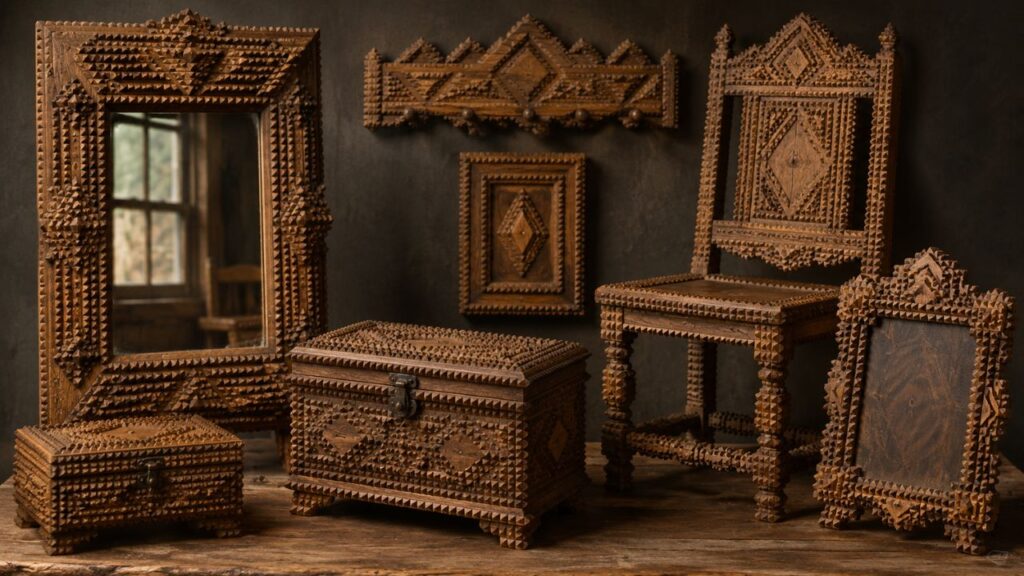
If you’ve ever run a finger over a real tramp art frame, you’ll instantly recognize the technique. The surface is built up in layers, usually three, five, or even seven. Each layer is notched — tiny V-shaped cuts made with a penknife — then stacked to create a stepped, pyramidal effect that catches light and shadow in a way that flat wood never can. The most common motifs are geometric: triangles, diamonds, hearts, and simple crosses. There’s a rhythm to the notching that feels almost meditative.
The wood itself tells stories. Cigar boxes were the material of choice, their thin cedar or mahogany veneers perfect for whittling. During the heyday of tramp art production, millions of cigars were sold in wooden boxes, and enterprising makers scooped them up from trash bins, general stores, and factories. You’ll also find pieces made from orange crates, old picture frames, and even dismantled packing pallets. The hardware — tiny brass nails, bits of mirror, and occasionally enamel paint — is almost always scavenged.
Because the style relies on repetition rather than formal training, no two pieces are ever the same. Even a simple tramp art box will show the maker’s individual rhythm in the spacing and depth of the notches. When you hold a piece, you’re essentially shaking hands with someone who, a century ago, spent hours turning trash into treasure.
Tramp Art Frames: Intricate Borders That Whisper Stories
Among collectors, the tramp art frame is probably the most recognized and beloved form. Walk into any high-end folk art gallery or browse a major auction catalog, and you’ll spot these frames holding old photos, tintypes, or sometimes nothing at all — they’re displayed as standalone pieces of sculpture.
A classic tramp art frame typically starts with a flat wooden base onto which the maker layered increasingly smaller notched strips, building a deep, textured border that juts out dramatically from the wall. Some frames have a single heart carved at the top; others spiral into elaborate sunburst patterns. The most elaborate examples feature multiple tiers, little corner rosettes, and even small shelves or niches built right into the frame. I once saw an 1890s frame that held a tiny hand-tinted photograph of a stern-looking couple, the frame itself a full eight inches deep with seven distinct layers of notched wood — all cut from cigar box lids stamped with Spanish-language tax seals.
Pricing on tramp art frames varies wildly. A simple, undamaged frame might sell for $75 to $200, while a large, multi-tiered masterpiece with original glass and a period photograph can command $1,500 or more. Look for frames with original varnish that’s mellowed into that honey-amber glow; refinishing destroys value instantly.
But here’s a tip many new collectors miss: a tramp art frame wasn’t always made to hang on a wall. Some were designed to stand on a mantel or dresser, with a folding strut on the back cobbled together from scrap tin. These easel-back frames are rarer and highly sought after.
Tramp Art Mirrors: Reflections of Folk Ingenuity
If frames are the gateway drug, tramp art mirrors are the heart-stopping find you brag about for years. A tramp art mirror takes the layered frame concept and inserts a looking glass — often an old, beveled mirror plate repurposed from a broken dresser or a traveling salesman’s sample case.
The beauty of a tramp art mirror lies in how the carved wood frames the reflection. Makers frequently built up tall, church-like arches around the glass, incorporating tiny drawers or candle shelves at the base. I recall a mirror I nearly won at auction in Ohio that had a pair of tiny, chip-carved birds perched on either side of the glass, all held together with brad nails so fine they looked like bee stings. It sold for over $3,000 — and I still think about it.
What makes mirrors particularly fascinating is their practical function mingled with artistic expression. A rail-riding laborer might craft a tramp art mirror as a gift for a sweetheart or a barter item for lodging. The mirror plates are often old, with bubbles and wavy imperfections in the glass that confirm their age. If you’re hunting for one, check the back: genuine pieces usually show saw marks, old square-head nails, and wood that has oxidized consistently. Beware of newly made “tramp art” where the glass is too perfect and the wood smells of fresh stain.
Collectors prize mirrors with original mercury glass, those that retain their cloudy, antique patina. A diminutive tramp art mirror, maybe 10 inches tall, might bring $150-$400, while a large wall-mounted example with candleshelves can easily fetch north of $2,000 at a specialist folk art auction.
Tramp Art Furniture: Chairs, Cabinets, and Whimsy on a Larger Scale
If you think tramp art furniture sounds improbable — I mean, can you really build a functional chair out of layered cigar-box wood? — you’re in for a treat. Yes, makers scaled up their chip-carving techniques to produce tables, chairs, plant stands, hanging shelves, and full-blown cabinets. The result is furniture that walks a fine line between sturdy utility and eccentric sculpture.
Most tramp art furniture pieces are small in scale. A typical side table might stand only 24 inches tall, its legs assembled from stacked, notched blocks glued and nailed together, the top built up with concentric layers of diamond-cut veneer. I’ve seen a corner cabinet where every surface — doors, sides, even the interior shelves — was covered in the same repetitive chip carving. It must have taken thousands of hours. When you sit in a tramp art furniture chair (carefully, because they’re often fragile), you’re supported by a lattice of tiny wood shards that somehow coheres into a solid form.
The market for tramp art furniture is thinner than for frames and boxes, partly because pieces are less common and harder to ship. A charming plant stand might sell for $300 to $800. A massive, baroque-inspired tramp art cabinet recently hammered for $4,200 at a Northeast auction. Museums like the American Folk Art Museum in New York have included tramp art furniture in their permanent collections, showcasing pieces right alongside weathervanes and quilts. The late folk art scholar Helaine Fendelman, who literally wrote the book Tramp Art: A Folk Art Phenomenon, documented dozens of furniture forms that ranged from rough-hewn to astonishingly refined.
When evaluating tramp art furniture, pay close attention to construction. Authentic pieces use period-appropriate nails, hide glue that has crystallized with age, and wood with a dark, lived-in surface. Any signs of modern Phillips-head screws or yellow wood glue are dead giveaways of a reproduction — or worse, an outright forgery.
Tramp Art Boxes: Small Treasures of Notched Wood
Of all the forms, the tramp art box may be the most intimate. These little containers, from ring-sized cubes to sewing chests with multiple drawers, were often made for a specific person or purpose. I have a soft spot for them because they fit in your palm and carry such quiet dignity.
A typical tramp art box starts with a basic wooden form that’s then wrapped in layers of chip-carved ornament. The lid might feature a raised heart or a cross, the sides paneled with zigzag borders. Inside, you’ll often find traces of the original use: a faint whiff of tobacco, a scrap of velvet lining, or tiny brass hinges salvaged from something else. Some boxes have hidden compartments, an extra thrill for collectors who like a little mystery.
Because they’re small, tramp art boxes survived in greater numbers than larger pieces, and they show up regularly at estate sales and online marketplaces. A simple, undecorated box might sell for under $50, while a multi-drawer jewelry casket with elaborate tiered tops and original finish can run $500 to $1,200. I once bought a box at a yard sale for $3 — the seller thought it was a camp craft project from the 1970s — that turned out to be a 1920s sewing box with six functioning drawers, each tiny knob painstakingly whittled. It now lives on my dresser holding watch parts.
Look for wear patterns that make sense: contact points on the base, wear around the latch, and a patina that’s darker in the crevices. The interior should show some discoloration but not the uniform, suspiciously clean look of a modern reproduction. And please, never strip a tramp art box — that crusty old varnish is its resume.
Hobo Art: More Than Just Another Name
I’ve already mentioned that many people use hobo art interchangeably with tramp art, but the term deserves its own conversation. The label “hobo” conjures a specific image: a transient worker, traveling by freight train, carrying a bindle, living on the margins of society during the late 19th and early 20th centuries. The reality is that some tramp art was indeed made by itinerant men who carved as a way to pass time in hobo jungles (makeshift camps near rail yards) and who bartered their creations for food or shelter.
Yet the umbrella of hobo art is emotionally resonant. It speaks to the resourcefulness of people who had nothing but a pocketknife and access to discarded wood. Folklorists have noted that not all tramp art makers were literal hobos — many were settled home-owners, prison inmates, or hospital patients — but the archetype endures because it captures the independent, outsider spirit of the work. For today’s collectors, hobo art feels like a direct line to the vanishing American frontier and the Great Depression’s lean years.
The difference in terminology rarely affects the market, though some purists insist “tramp art” is the more historically accurate umbrella. At shows and shops, you’ll hear both terms, and I’ve never seen a dealer correct a customer on it. What matters is the piece itself. Whether you call it hobo art or tramp art, the craftsmanship speaks a language of patience, necessity, and hard-won beauty.
How to Identify Authentic Tramp Art (And Spot the Fakes)
The surge in popularity has invited a wave of reproductions, many coming from overseas workshops that have gotten distressingly good at mimicking the look. Here’s what to check when you’re holding a potential purchase.
- Wood and Smell. Old tramp art smells old — like attic dust, tobacco, and time. The wood should be darkened unevenly, with random nail holes and perhaps traces of cigar-box labels still visible inside. New pieces smell like lumberyard pine or chemical stain.
- Nails and Hardware. Early makers used cut nails, wire brads, or small round-head nails that have oxidized black. You won’t find shiny zinc screws. If you see Phillips-head screws, walk away.
- Tool Marks. Under magnification, authentic notches show a slight irregularity — the tiny slip of a penknife, a variation in cut depth. Machine-made reproductions look too uniform, almost stamped.
- Wear and Patina. Genuine patina is built up in layers of grime, old wax, and smoke. The contact points (bottom edges, handles) should show legitimate wear. A piece that’s uniformly dirty without areas of high-contact wear is probably artificially aged.
- Provenance. Pieces that come from old estates or have a traceable history boost confidence, but honestly, most tramp art arrives undocumented. Buy from reputable dealers who specialize in Americana or folk art.
One of the biggest rookie mistakes is assuming all heavily notched wooden items are old. I’ve seen newly crafted “tramp art mirrors” at import stores that look convincing at ten feet. Up close, the wood is too light, the glass too perfect, and the assembly too precise. Trust your gut, and if a price seems too good to be true on an elaborate piece, it probably is.
Caring for Your Tramp Art Collection
Once you bring a piece home, the rule is simple: do no harm. Tramp art’s fragile, layered construction can loosen with humidity swings, and overcleaning can strip away the very evidence of age that gives it value.
- Dust gently with a soft, dry brush — think a clean artist’s paintbrush or a makeup brush — never a damp cloth, which can lift fragile veneer.
- Keep it out of direct sunlight to prevent bleaching the dark patina.
- Avoid wood polish or oils. Most tramp art was never meant to have a glossy, nourished finish. Adding lemon oil or wax can turn sticky and attract dirt, permanently altering the surface.
- Stabilize, don’t restore. If a layer has separated, resist the urge to glob on carpenter’s glue. Consult a furniture conservator who understands folk art; they can use reversible adhesives that won’t outgas and damage the wood over decades.
I keep my tramp art box collection in a glass-front cabinet with a small humidity gauge. It’s a bit obsessive, but these pieces have survived a hundred years of rough handling — the least I can do is give them a stable, quiet retirement.
FAQ: Common Questions About Tramp Art
What is tramp art and how old is it?
Tramp art is a chip-carved folk art made from recycled wood, primarily between the 1870s and 1940s. Its name reflects the romantic notion that traveling hobos made these pieces, though settled craftspeople created many as well.
Why is some tramp art called hobo art?
Hobo art is a popular synonym, stemming from the association with itinerant workers during the Great Depression. Both terms describe the same notch-carved, layered wood pieces, though “tramp art” is preferred in academic circles.
How can I identify a genuine tramp art frame?
Check for irregular notching, old square nails, darkened patina, and appropriate wear. The wood should show signs of age, often with remnants of cigar box labels, and the construction should feel hand-done rather than machine-perfect.
Are tramp art mirrors valuable?
Yes, especially large examples with original beveled glass, intricate multiple layering, and extra features like candle shelves or small drawers. Prices range from a few hundred dollars to several thousand.
What’s a fair price for a tramp art box?
Small, simple boxes can be found for $40–$100, while elaborately layered multi-drawer boxes command $500 and up, depending on condition, size, and aesthetic appeal.
Did hobos really make tramp art furniture?
Some certainly did, but many makers were also homebound individuals, prisoners, and farmers using scrap materials. Large tramp art furniture pieces are rare and sought after by advanced collectors.
The Enduring Spell of a Pocketknife and Scrap Wood
At the end of the day, tramp art matters because it’s proof that creativity doesn’t require a studio, a trust fund, or formal training. It asks only for time, patience, and the stubborn belief that a pile of discarded cigar boxes can become something worth keeping. Every notch I see in a tramp art frame, every wobble in a tramp art mirror, every hidden compartment in a tramp art box feels like a tiny act of defiance against throwaway culture.
If you’re just starting out, grab a modest piece that speaks to you — maybe a little frame that can sit on your desk. Turn it over. Run your thumb across the wood. Somebody, a long time ago, stood where you are now and decided to make beauty from what the world had thrown away. That’s a legacy worth collecting.