
Most homeowners walk past their basement door every single day without realizing they’re ignoring one of the most valuable renovation opportunities in their entire house. Adding a bathroom below grade isn’t just a convenience upgrade — it can increase your home’s resale value by 10 to 20 percent, according to data from the National Association of Realtors. If you’ve been sitting on an unfinished lower level, exploring basement bathroom ideas might be the smartest project you tackle this year.
The challenge, of course, is that basements aren’t exactly forgiving spaces. Low ceilings, limited natural light, moisture concerns, and the complexity of basement bathroom plumbing can make the whole thing feel overwhelming before you even pick up a pencil. But with the right approach, a below-grade bathroom can be just as beautiful, functional, and comfortable as anything on your main floor.
Whether you’re planning a simple half-bath for guests, a full spa-style retreat, or a practical utility bathroom near a home gym, the ideas and strategies in this guide will help you move from concept to completion with confidence. Let’s dig into what actually works — and what to watch out for.
Understanding the Basics of Basement Bathroom Plumbing
Before you fall in love with a particular tile pattern or vanity style, you need to understand the mechanical reality of your project. Basement bathroom plumbing is fundamentally different from above-grade work, and it’s the single biggest factor that will shape your budget, timeline, and design options.
Why Gravity Is Your Biggest Challenge
In a standard bathroom, waste flows downward through your home’s drain-waste-vent (DWV) system and exits through the main sewer line. In a basement, your fixtures often sit below or at the same level as that main sewer line. That means gravity alone can’t do the job.
You have two primary solutions. The first is breaking through the concrete floor to tie directly into the existing drain system — a labor-intensive but highly reliable approach. The second is installing an upflush toilet system, sometimes called a macerating toilet, which grinds waste and pumps it upward to connect with your existing plumbing. Upflush systems like those made by Saniflo are popular for basement bathrooms because they don’t require jackhammering the slab, though they do require electricity and regular maintenance.
Rough-In Plumbing: What You Need to Know
If your basement already has a rough-in — a capped drain stub-out in the floor — you’re in luck. Many builders install these during original construction, anticipating future bathroom additions. A standard rough-in includes a toilet drain (typically 3 inches), a shower or tub drain (2 inches), and a sink drain (1.5 to 2 inches).
If you don’t have a rough-in, you’ll need a licensed plumber to cut into the concrete and install one. This typically costs between $1,500 and $4,000 depending on your location and the complexity of the work. It’s not a DIY job — improper slope or venting can cause chronic drain problems that are expensive to fix later.
Always pull the necessary permits before starting basement bathroom plumbing work. Inspectors exist to protect you, and unpermitted plumbing can create serious headaches when you sell your home.
Basement Bathroom Ideas for Small or Awkward Spaces
Most basements don’t offer the luxury of a sprawling floor plan. You’re often working around support columns, mechanical equipment, and irregular wall angles. The good news is that some of the most creative basement bathroom ideas come from working within tight constraints.
The Half-Bath: Maximum Impact, Minimum Footprint
A half-bath — just a toilet and sink — requires as little as 18 square feet of floor space. For a basement that’s primarily used as a rec room or home office, a half-bath is often all you need. It eliminates the constant trip upstairs and makes the space genuinely livable.
Design-wise, small half-baths are actually a great opportunity to go bold. Because the space is compact, you can afford to use a dramatic wallpaper, a statement mirror, or an unusual vanity without overwhelming the room. A vessel sink on a floating shelf, for example, takes up almost no visual weight while looking intentional and modern.
Three-Quarter Baths: The Sweet Spot for Basement Living
If your basement functions as a guest suite, in-law apartment, or teenager’s hangout, a three-quarter bath — toilet, sink, and shower — hits the sweet spot between cost and functionality. You don’t need a tub, which saves significant space and money, and a well-designed walk-in shower can actually feel more luxurious than a tub-shower combo.
For tight spaces, consider a corner shower with a neo-angle door or a curbless shower with a linear drain. Curbless designs are also ADA-friendly and easier to clean, which is a practical bonus that most homeowners appreciate after a few years of living with the space.
Working Around Columns and Mechanical Equipment
Basement support columns and HVAC equipment are non-negotiable — you can’t move them, so you design around them. A column in the middle of your planned bathroom isn’t necessarily a dealbreaker. Some designers use columns as natural dividers between the toilet area and the vanity, or even wrap them in tile to make them a visual feature rather than an obstacle.
If your water heater or furnace sits adjacent to your planned bathroom space, make sure you maintain the required clearances for service access. Building codes typically require 30 inches of clear space in front of mechanical equipment, and your inspector will check this.
Choosing the Right Layout for Your Basement Bathroom
Layout decisions in a basement bathroom carry more weight than in above-grade spaces because moving plumbing is expensive and disruptive. Getting the layout right the first time saves you money and frustration.
Single-Wall vs. Wet Wall Configurations
In a single-wall layout, all your plumbing fixtures line up along one wall, sharing a single wet wall. This is the most cost-effective configuration because it minimizes pipe runs and simplifies venting. If you’re working with a tight budget or a narrow space, single-wall layouts are almost always the right call.
More complex layouts — where the toilet is on one wall and the shower on another — require additional plumbing runs and more complex venting. They can look more custom and feel more spacious, but they add cost. In most basement bathrooms under 60 square feet, the single-wall approach is both practical and visually clean.
Ceiling Height Considerations
Standard residential ceiling height is 8 feet. Many basements, especially in older homes, have ceilings of 7 feet or even lower. Building codes in most jurisdictions require a minimum ceiling height of 6 feet 8 inches in bathrooms, but that’s a minimum — not a comfortable standard.
If your basement ceiling is below 7 feet, you’ll want to be strategic about lighting and design choices. Recessed lighting instead of pendant fixtures, frameless shower enclosures instead of framed ones, and wall-mounted toilets instead of floor-mounted ones all help a low-ceiling bathroom feel taller and less cramped.
Waterproofing and Moisture Control: The Non-Negotiable Foundation
Here’s something that experienced contractors will tell you plainly: a beautiful basement bathroom that hasn’t been properly waterproofed is a disaster waiting to happen. Moisture is the enemy of every material in a bathroom — drywall, flooring, cabinetry, and even tile grout.
Interior vs. Exterior Waterproofing
Exterior waterproofing involves excavating around your foundation and applying a waterproof membrane to the outside of the wall. It’s the most effective long-term solution but also the most expensive, often running $10,000 to $30,000 or more depending on your home’s footprint.
Interior waterproofing — drainage channels, sump pumps, and vapor barriers — is more common for basement bathroom projects because it’s significantly less disruptive and expensive. A properly installed interior drainage system can manage water intrusion effectively, though it redirects water rather than stopping it at the source.
For the bathroom itself, use cement board (not standard drywall) behind tile in wet areas, apply a waterproof membrane over the cement board in the shower, and seal all penetrations carefully. These steps aren’t optional — they’re the difference between a bathroom that lasts 30 years and one that develops mold problems within five.
Ventilation in Below-Grade Bathrooms
Basements naturally have less air circulation than above-grade spaces, which makes proper ventilation even more critical in a basement bathroom. A bathroom exhaust fan is required by code in any bathroom without an operable window, and in a basement, you should treat it as mandatory regardless.
Look for a fan rated for at least 50 CFM for a small bathroom, or 1 CFM per square foot for larger spaces. The fan must vent to the exterior — not into the ceiling cavity or another room. In a basement, this often means running ductwork horizontally through the rim joist to exit through the foundation wall.
Design Ideas That Make Basement Bathrooms Feel Bright and Spacious
The most common complaint about basement bathrooms is that they feel dark, cave-like, or institutional. Smart design choices can completely change that perception, even without natural light.
Lighting Strategies That Work Below Grade
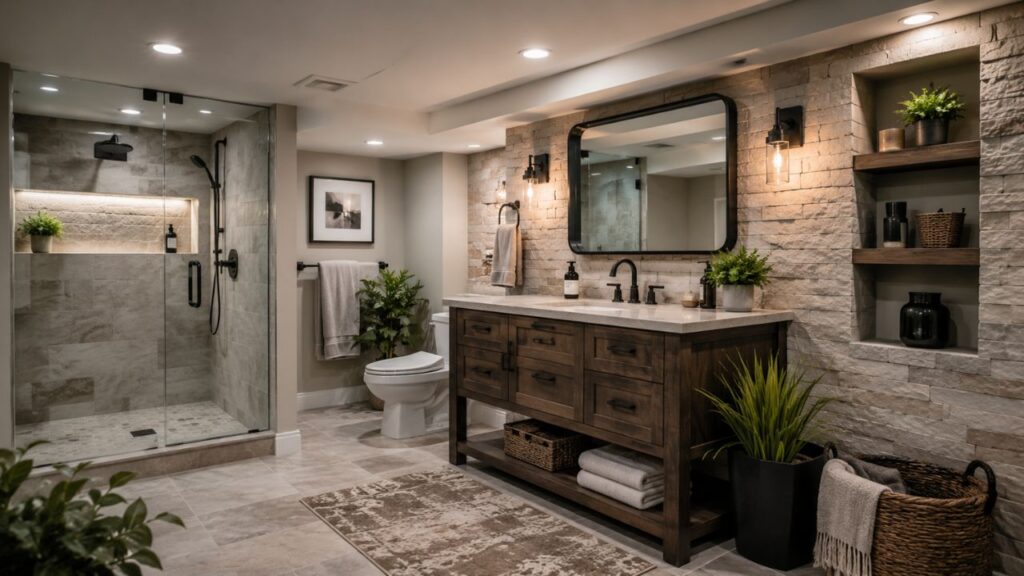
Layered lighting is your best friend in a windowless basement bathroom. Combine recessed ceiling lights for general illumination, vanity lighting at face level to eliminate shadows, and accent lighting inside the shower or along the floor for depth and warmth.
LED strip lighting under a floating vanity creates a soft glow that makes the floor appear to recede, visually expanding the space. Warm white LEDs (around 2700K to 3000K) feel more inviting than cool white, which can make a basement bathroom feel clinical.
Tile Choices That Brighten and Expand
Large-format tiles — 24×24 inches or bigger — have fewer grout lines, which makes a floor or wall look more expansive. Light-colored tiles in white, cream, or soft gray reflect light and keep the space feeling open. If you want to add visual interest without darkening the room, consider a subtle texture or a matte finish rather than a bold pattern.
Vertical tile installations on walls draw the eye upward, which helps in rooms with lower ceilings. A floor-to-ceiling tile treatment in the shower, for example, makes the shower feel taller and more intentional.
Color Palettes That Work Underground
Stick with light, neutral base colors for walls and large surfaces — white, warm greige, soft sage, or pale blue. These colors reflect the artificial light you’re working with and prevent the space from feeling heavy.
You can introduce deeper tones through accessories, towels, hardware, and accent tiles without committing to a dark room. Matte black fixtures against white tile, for example, is a high-contrast look that feels contemporary and sophisticated without making the space feel smaller.
Budgeting for Your Basement Bathroom Project
Realistic budgeting is one of the most important parts of planning a basement bathroom, and it’s where many homeowners get into trouble by underestimating costs.
Typical Cost Ranges
A basic half-bath in a basement with an existing rough-in typically costs between $3,000 and $8,000 for materials and labor. A full three-quarter bath with a shower, tile work, and quality fixtures generally runs $10,000 to $25,000. A full bath with a tub, custom tile, and high-end finishes can easily exceed $30,000.
The biggest variables are plumbing complexity, whether you need to break concrete, the quality of your fixtures and finishes, and local labor rates. In high cost-of-living areas like New York, San Francisco, or Boston, expect to add 20 to 40 percent to national average estimates.
Where to Spend and Where to Save
Spend on plumbing and waterproofing — these are the bones of the project, and cutting corners here creates expensive problems later. Spend on ventilation and lighting, which dramatically affect how the finished space feels.
Save on decorative elements that are easy to change later: mirrors, towel bars, toilet paper holders, and even vanity lights. These are the accessories you can upgrade over time without touching the structure of the bathroom.
Frequently Asked Questions
Do I need a permit to add a basement bathroom?
In virtually every U.S. jurisdiction, yes. Adding a bathroom involves plumbing, electrical, and potentially structural work — all of which require permits and inspections. Skipping permits might seem like a shortcut, but it can result in fines, required demolition, and serious complications when you sell your home. Always check with your local building department before starting work.
How long does it take to finish a basement bathroom?
For a straightforward project with an existing rough-in, expect four to eight weeks from demolition to final inspection. More complex projects — especially those requiring concrete cutting, extensive waterproofing, or custom tile work — can take three to five months. Contractor availability in your area also plays a significant role in the timeline.
Can I install a basement bathroom myself?
Some elements are DIY-friendly: painting, installing a vanity, laying tile, and hanging fixtures. However, basement bathroom plumbing and electrical work should be handled by licensed professionals in most cases. Improper plumbing can cause sewage backups, water damage, and mold — problems that cost far more to fix than the labor you saved.
What is an upflush toilet and is it a good option?
An upflush toilet uses a macerating pump to grind waste and pump it upward to connect with your existing drain system. It’s a popular choice for basement bathrooms because it doesn’t require breaking the concrete slab. The trade-off is that upflush systems require electricity, need periodic maintenance, and are slightly louder than conventional toilets. For many homeowners, the convenience outweighs these drawbacks.
How do I prevent mold in a basement bathroom?
Mold prevention starts with proper waterproofing, adequate ventilation, and moisture-resistant materials. Use cement board behind tile, apply a waterproof membrane in wet areas, install a properly sized exhaust fan vented to the exterior, and consider a dehumidifier for the broader basement space. Keeping relative humidity below 50 percent is the most effective long-term mold prevention strategy.
What’s the minimum size for a basement bathroom?
A half-bath (toilet and sink) can fit in as little as 18 to 20 square feet. A three-quarter bath with a shower typically requires at least 35 to 40 square feet. A full bath with a tub needs a minimum of 50 to 60 square feet. These are functional minimums — more space always improves comfort and usability.
Is a basement bathroom worth the investment?
Most real estate professionals and appraisers agree that adding a bathroom to a home — especially in a basement that previously had none — adds meaningful value. The return on investment varies by market, but in most cases, a well-executed basement bathroom recoups 50 to 70 percent of its cost at resale, while significantly improving daily livability and buyer appeal.
Can I add a window to a basement bathroom for natural light?
In many cases, yes. A window well installation can bring natural light into a below-grade bathroom, and some homeowners opt for egress windows that also serve as emergency exits. This adds cost — typically $1,500 to $5,000 depending on the scope — but the improvement in natural light and air quality can be substantial. Check local codes for egress requirements if the bathroom is part of a sleeping area.
Wrapping Up: Making the Most of Your Below-Grade Space
A basement bathroom is one of those projects that pays dividends in ways you don’t fully appreciate until it’s done. The convenience of not sending guests upstairs, the added functionality for a home gym or guest suite, the genuine increase in your home’s market value — these benefits compound over time in ways that most renovations simply don’t.
The key is approaching the project with clear priorities. Understand your plumbing situation before you fall in love with a design. Invest in waterproofing and ventilation even when it feels like money spent on things you can’t see. Choose materials and layouts that work with your space’s natural constraints rather than fighting against them. Basement bathroom ideas work best when they’re grounded in the specific reality of your home, not just pulled from a magazine spread.
Whatever direction you take — a sleek modern half-bath, a spa-inspired shower retreat, or a practical full bath for a growing family — the basement beneath your feet holds more potential than most people ever realize. The right plan, the right team, and a clear-eyed budget are all you need to turn that underused space into something genuinely worth showing off.